
#BROZERDiceless
A rough and ready AAR

Condensing a month of gaming into a useful AAR is a daunting task. For those wanting a more in depth look under the hood, please bear with me as I get a more long form write-up put together. This has been a very busy season. The Braunless Dicestein write up is in the works as well.
The System
Amber Diceless has a very simple set of character creation and resolution mechanics - you have a pool of points, you use them to point buy stats and items, and then when you come into conflict, the person with the highest score in the relevant stat for the contest wins. There’s a lot of narrative managing, Amber specific powers and rules, but at its core this is the system. I will post more about the system in the longer writeup, but it really isn’t crazy.
The Setup
My biggest takeaway from the Braunless Dicestein was that the default fog of war is too thick. As a player, I crave intel - it doesn’t have to be good, it just has to be there. I made some moves in that game that were orchestrated carefully to avoid detection, but in hindsight would lead to a turtling situation if adopted en masse. The goal of braunstein is interaction between players, and intel allows those interactions to have more complex depth. In that game, I actively conspired with the other players to try and tease out as much info as possible to make my choices, but this isnt a sustainable option once tactical Darwinism sets in and is liable to lead to turtling eventually too. My solution was simple, and paid immediate dividends — GOSS. I will spell it out in the what ‘was good section’ below, and I encourage you all to steal it for your long form braunsteins, wargames, and campaigns!
My second biggest takeaway was that Jeffro and Bdubs’ suggestion to adopt Appendix N character motivations was genius. I took it a step further and set explicit goals for myself based on the character I modeled mine after, and it drove some really unique situations. I made appendix N goals an explicit requirement for this game, though I asked players not to inform me of them so I could enjoy the game as an observer as well as judge.
My third takeaway was that Amber Diceless provided a powerful framework for simple braunstein that could generate near limitless game content, if used with a blind auction to conceal relative power levels, but there was room for improvement. In the Braunless Dicestein we had one character die in one month, because the stakes of combat were so certain and so high we mostly avoided it. I attempted to expand on this by adding a hit point mechanic (resilience), a new combat stat (cunning), a non combat stat to be used in covering up or discovering covert actions (influence, which Rdubs decided to turn into a combat stat) and an expendable resource called tricks that could be used to simulate the narrative push/pull of combat, pursuit, and evasion described in Amber Diceless without requiring me to be actively involved in reffing it.
Tricks were intended to concretely and fairly handle the narrative shifting illustrated in the Amber Diceless rule book where players could leverage other stats to change the outcome of a contest or avoid certain death, and abstractly simulate the kind of meticulous planning players like to get up to.
I did not want this to be a wargame. Amber Diceless is not readily adopted for that purpose and it would have been taxing on my end to work it as such, so I made a few modifications to Brozer for this to work.
I created a central location — Brozer City — to drop the factions in. The intention was to minimize the maneuver aspect and maximize the interaction.
I was explicit that the players would be in control of a faction leader and not a faction — the faction itself would be encompassed by the Diceless stats of the faction leader. The only outcomes possible of conflict were death, victory, or depleting the resources of an opponent so that victory could be achieved at a later time.
I informed the players that we would be using the information in Brozer as inspiration not gospel. I told them that the alignments especially were not accurate, and that I would be changing them to create more uncertainty.
I gave them carte blanche to meme about what they and their faction were overtly doing in the world and guidelines on what was possible. This was intended to generate context for action, intel on the other factions, and ultimately more engagement.
Three covert actions could be taken in weekly turns. This was more because of my time constraints than anything. The guidance I gave was that the actions should be directly against other players in some way. This guidance was not always heeded.
The game would be played exclusively on X, and apart from covert actions and gossip, entirely between the players in private chats.
For the inciting incident, I expanded on the MacGuffinstone idea in Brozer. Instead of placing it in a random location, I broke it into pieces and distributed to some of the faction leaders. The intent was that they would have to interact with each other instead of the game world to locate them. They were told they needed three to unlock its power, that four existed, but I secretly placed five for redundancy.
We started with 16 players, enough for every faction in Brozer to be covered, and had to create two new factions - Polywog News Network and Gray Harry Hausen with his stop motion creations, and one pseudo faction that was exceptionally ridiculous — Muppet Angel of the Muppet Martians — that wasn’t really playing but acting as a misinformation agent throughout the game. More on that in the GOSS section below.
The Play
For my part, I responded to messages, stepped in to ensure combat went fairly, resolved covert actions, and posted gossip. I had little idea about what was going on beyond what I needed to know for resolution. It was fun, and truth be told pretty easy. This was a tough month for me to put this on, but when the call came from the tribal council to run Brozer I knew I would have to make do. I probably spent two or three hours at most each week doing necessary tasks for the game.
I got roped into adjudication almost immediately because Chaz wanted to host a gala. What is with braunsteins and dress up parties? I digress. Needless to say, this set the tone, and I ended up having to be involved in nearly every combat that was run, even though I did not intend this to be the case.
I got more good covert actions than bad. The biggest limit here was my time. People were spying, sending assassins, and spreading misinformation (see GOSS) and a lot of cool scenarios came about from convergent action. I took an active part, bending these into scenarios that I felt would be worth playing out. I will describe one, as an example.
The Imperator of Drakonia, a reskin of Drakon from Brozer, was the target of multiple covert actions in the first two weeks. A series of actions converged, leading to multiple fatalities.
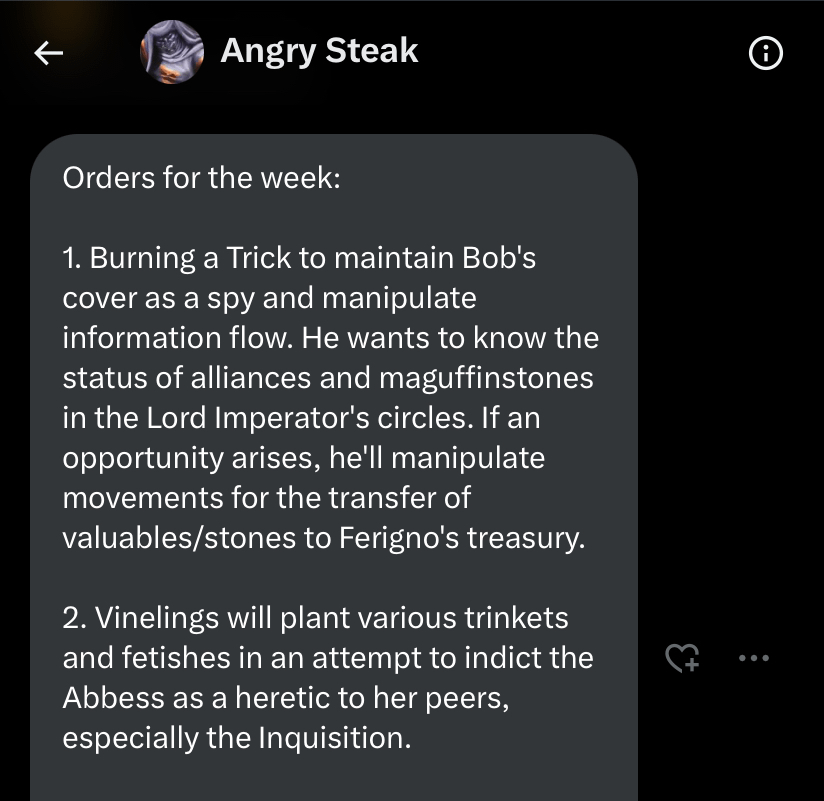
Ferigno decided he would go dark and no contact after a fight with Hanzen Franzen at the gala Chaz put together, but would continue working through his subordinates. He decided he wanted BOB to possess someone inside of Drakonia to spy and intercede if an advantageous situation presented itself.
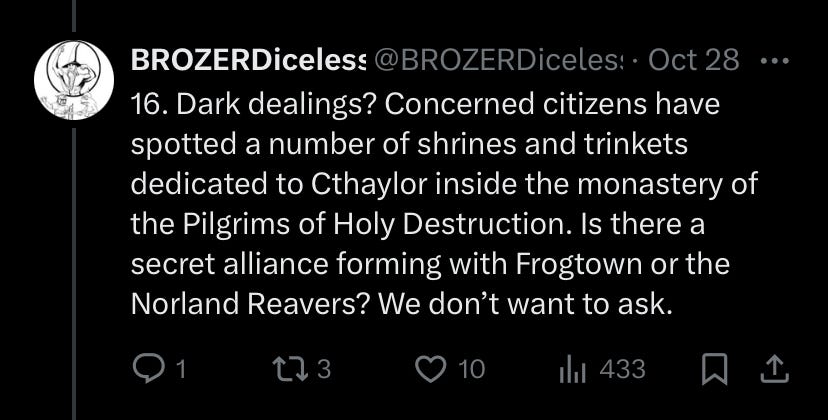
Ferigno planted trinkets and spread a rumor implicating the Pilgrims of being heretics - I embellished this as Cthaylor worship and it came out in the GOSS
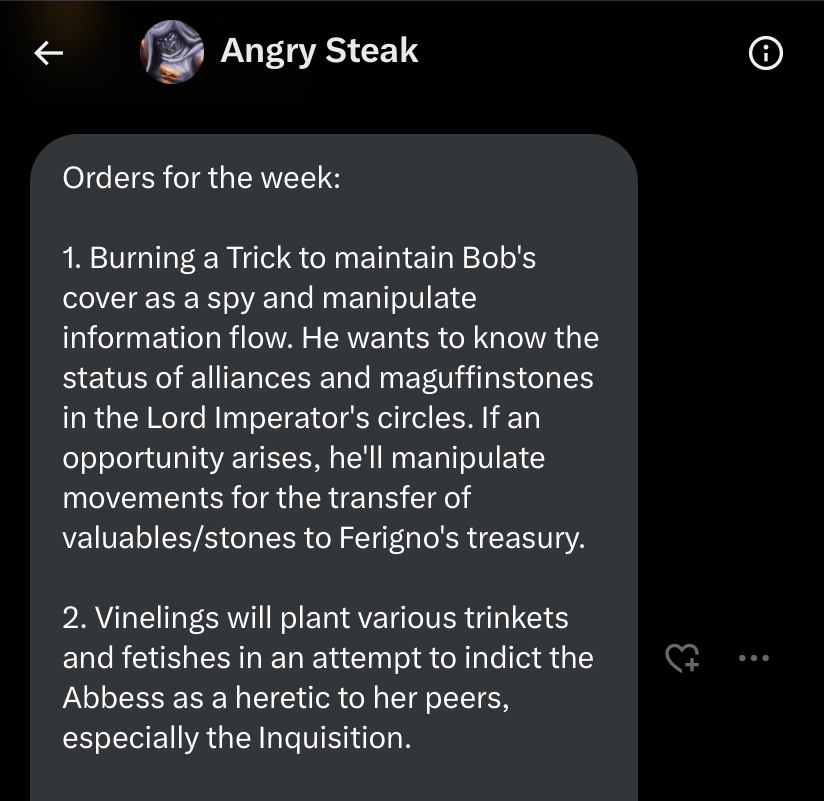
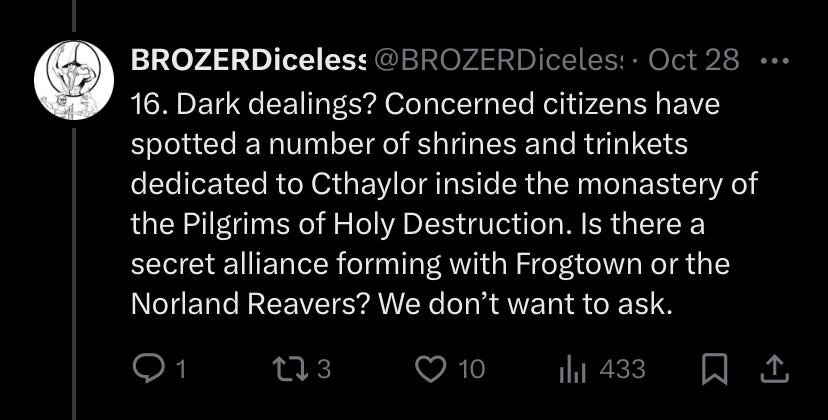
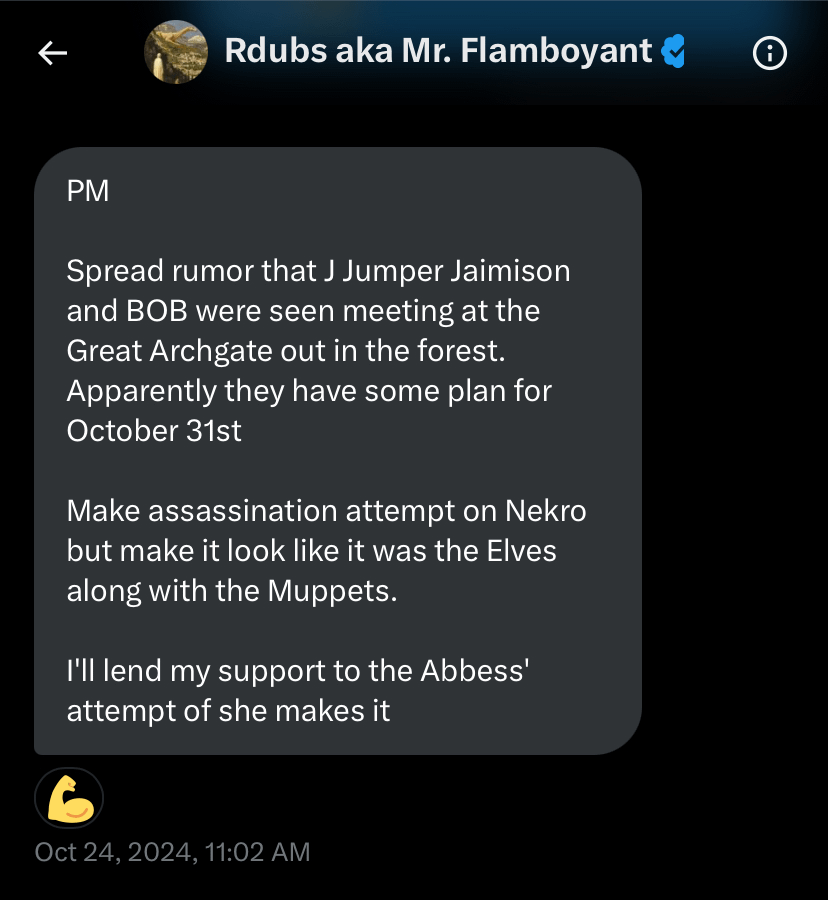
The Inquisition attempted an assassination against the Imperator, with the intent to frame the Elves and Muppet martians.
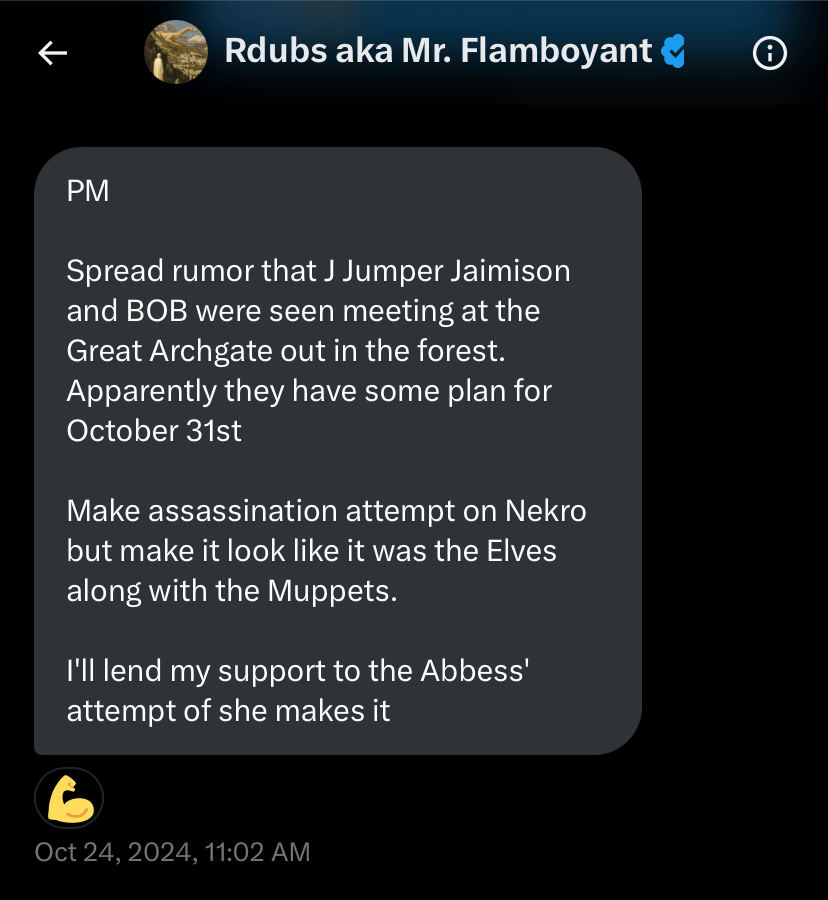
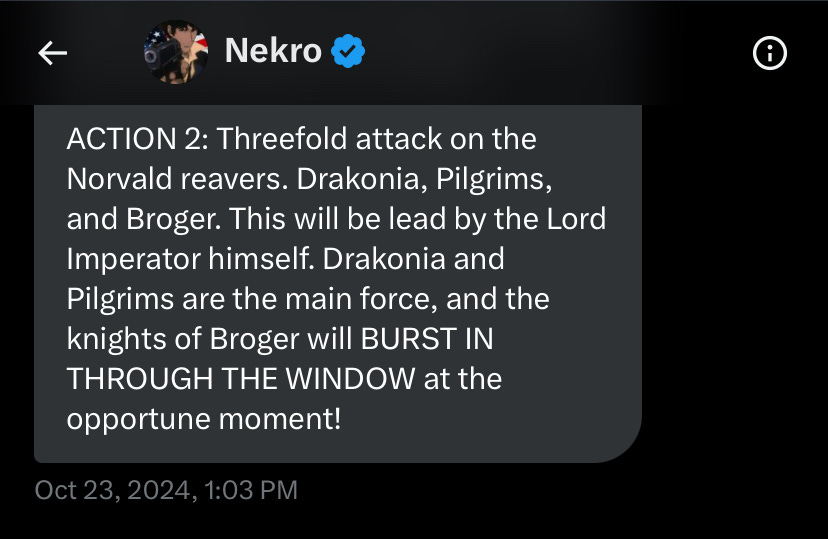
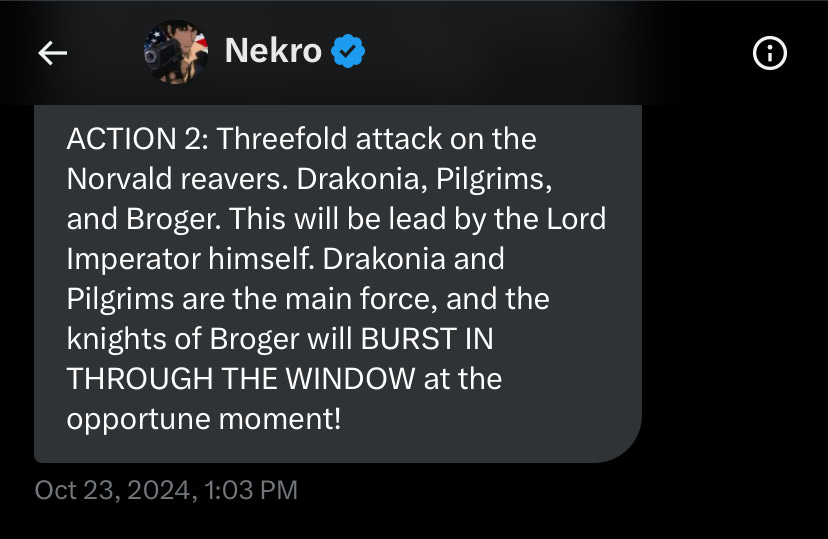
Drakonia, the Pilgrims, and Broger de Brozer attacked the Norland Reavers. Three of the four combatants had received MacGuffinstones at the start.
How did I resolve this?
First I resolved the assassination attempt, but knowing that BOB was in a position close to the target I gave him a choice to intervene and prevent it, and if he chose to spend a trick he could control the information. He did, discovered the Inquisition’s involvement and desire to pin it on the elves and muppets. Ferigno decided BOB was going to implicate the Abbess and the Inquisition in the attempt.
Second I launched the attack on the Reavers. Broger was held in reserve, per the order, and I brought him in at an opportune moment (I forgot until I was reminded). This led to the death of Capt Angus Macready. What I didn’t expect was that the rumor Ferigno spread would lead Broger to suspect the Abbess. Another battle ensued, the Imperator held back, and the LG Broger de Brozer killed the LG abbess. There was some roleplay, and ultimately Broger escaped, leaving the stoneless Imperator with possession of two stones but no tricks.
I hadn’t informed the Imperator of the assassination attempt yet, and with the raid on the reavers just wrapped up, I remembered BOBs mission was to acquire stones— as fate would have it, the Imperator was helpless and came back to his estate with two of them. I couldn’t imagine BOB wouldn’t capitalize on a barrel shoot like this. Broger was a perfect fall guy after the conflict. I messaged Ferigno and told him he could spend his last trick to kill the Imperator. He would be mad if he didn’t. He accepted the offer. I roleplayed the surprise attack with the Imperator’s player. He was shocked. It was intense and exhilarating.
At the end of this, Ferigno had two stones, three characters were dead, and we had a big shakeup in the game state. Every part of the whole happened organically based on character motives, goals, and prior actions. This is just one convergence, though there were at least 5 of them, and there could have been more if I was more diligent.
Not every player was active the whole month. A few players were sparse from the beginning, but even their minor involvement had a huge impact on the game. The Yuun Dineh mostly posted memes, but their involvement in the game changed the calculus for several of the significantly active players. Hanzen Franzen was another character that did almost nothing covertly, but the memes drove action.
What was good?
Jeffro has said as much before, but it bears repeating - the key to braunstein is player interaction! Anyone trying to run one should try to maximize this as much as possible! It’s easier to do with a session braunstein, because interaction is a function of player engagement, and engagement is much easier to maintain for a session than a month. It’s harder to do with a downtime braunstein. I was fortunate to be blessed with great players that remained engaged the entire month. Even though some of the others waxed and waned, there was a group of five or six that were submitting orders and interacting the whole time. I am grateful to them. I’m certain that the players who got the most enjoyment out of the game were the ones who put in the most effort to engage, and there’s a 1:1 correlation.
My thesis was that Information leads to Engagement leads to Interaction — that the default fog of war was too thick and too subjective, inadvertently killing engagement in long form games, leading to stagnation and diffusion. I worked as a player to prevent this in Braunless Dicestein. Appendix N archetypes, motivations, and concrete goals based on them worked. But I wanted to see if a system could make it more sustainable. This is what led me to GOSS.
GOSS stands for General Observation Sub System, and is also slang for gossip. It works both ways. My thought process was that a fictional world would be filled with casual observers, who might make basic observations about things intended to be done in secret and gossip about them, spreading both truth and lies with aplomb.
AD&D has rules for spying, and the hireling rules inform you that anyone can be a spy at the DMs discretion. So what about ordinary people spreading gossip? Why not.
The formula is intentionally simple. I looked at the numbers for a 1st level spy on an easy spying mission and adjusted it a little. My belief is that it should be skewed first towards rumor leading in the right direction so that all the rumors are taken seriously, and secondly towards information over no information, so that it feels like things are happening and you need to act.
How does it work?
Anytime a player takes an action in secret, roll 1d6.
1 - Action remains secret. No post.
2 or 3 - Misinformation! Post a rumor about anyone else in the game.
4, 5, or 6 - On the right track! Post a rumor that hints at what’s really going on.
You should neither keep your players in the dark nor give them everything in the rumor. The key is to post from the perspective of a common observer who isn’t particularly perceptive.
Example -
Action: Macho Mandalf produces an army of puglins in secret.
Rumor: Strange noises are heard from within the inner sanctum of Minas Mandalf.
This tips off your players that ‘something is habbening’ without telling them what Mandalf is up to. It’s up to them to take action to get to the bottom of it. This will lead to conflict.
This system worked incredibly well for Brozer Diceless, and for other games where it has been used. Players may not like their secret actions being open to interference, but knowing from the start that this will be used forces them to dedicate resources to keeping things secret and open to the possibility of plans being frustrated. Expectation management is an important skill!
For this game, I gave them the option to spend limited trick resources to conceal actions from the rumor mill. For a game in a different system, I would let players keep one action/week secret. This balances the theme of secret actions with the need to drive towards conflict.
I also collaborated with Macho Mandalf, who didn’t have the time to be fully involved, to make a ‘faction’ I could use as a patsy to pin misinformation on. The Martian muppets took no actions the entire game, but because of gossip and enemy action became a fun part of the game nonetheless. The reputation of the man behind it likely played a part in this outcome.
I posted all the GOSS on the Brozer Diceless X account. You can see much of the engagement on the timeline. What you can’t see is the intangible ways it drove player action. The slight adjustments to the calculus of the game that each rumor had. There were several covert actions spent laundering rumors through GOSS to great effect, as seen in the death of the Abbess above, which ultimately led to the death of the Imperator and Ferigno taking possession of two stones! Second and third order effects! There were also several covert actions taken in response to the GOSS that shaped the overall game.
This is great tool to drive player engagement. When you feel like things are happening, you feel urged to involve yourself in them.
Other things that worked well -
BROZER was great! The essays alone would be worth paying for, but having all the factions spelled out with motivations made setting up the game relatively straightforward. It would have been even easier if I wasn’t trying to do something unconventional. If you haven’t run it yet, I encourage you to do so! You don’t need to do something big like we did to have a ton of fun. Even just three or four of the factions would make a great battle braunstein. If I was to do it, the natural tension between the inquisition and the elves make them a perfect pair, with another neutral faction and a truly lawful faction in the mix.
My one criticism of Brozer isn’t so much a criticism of the work as it is of this kitchen sink application of it and the LG nature of the bros - there are too many lawful and good factions! With 14 factions and 9 alignments to pick from, there are three LG factions, three questionably LN factions, and one NG faction. Thankfully, that didn’t impact this game too much because the Inquisition was made Chaotic, Drakonia was LN, Broger didn’t like the Pilgrims, the Swolecerors were relatively reactive, and the Rat King was N. It was an easy fix that cannot be held as true criticism by any means!
My takeaway is that concealed alignment is a boon to braunstein, and can help cut through the get along gang mindset with the pretense of uncertainty. I might even try concealed character classes going forward.
What was bad?
The hit point system I put in was functionally useless because of the way I implemented it. I was in a hurry to get this to the table with some improvements I thought necessary after Braunless Dicestein and didn’t think everything through all the way. A few characters wasted points into it that affected the overall outcome of the game, and that doesn’t feel good. They were good sports about it, thankfully, but it will need to be fixed before I attempt anything with this system again.
What could be improved?
The trick system quickly turned into a Rabbit Season/Duck Season contest. It wasn’t a total waste, but specifically in the context of combat it needs improvement. The meta quickly devolved into trick focused characters once the first round of faction leaders were killed.
The other thing I would improve is my ruleset strictness. There were a number of convergences that were played out with this system where I could have easily switched to AD&D and got a more engaging resolution. I chose not to because of time and the commitment to seeing the experiment through to the end. Going forward, that would probably be ideal. There’s a lot of potential with a Diceless braunstein, and it’s abstract enough that you could implement it in any game system and zoom in to that system as necessary to resolve complicated actions.
What’s next?
I’d like to see more people test out the GOSS system in their ongoing games. It’s a convergence generating machine! It’ll play a big part in the Braunsteinstein game once that gets played. I want to test it out as a player facing mechanic to be used in an always on game, as well as part of a larger scheme I’m working on to handle the flow of information and minimize the responsibility of the DM as a clearinghouse.
I’m going to be doing more Diceless experiments in the future - it was easy to run, easy to play, and the amount of creative game content produced for the effort was unparalleled. The system has virtually no bar for mastery, and that’s a significant virtue for dynamic campaign action. The other advantage is that there is no benefit to turtling. The only real game with this system is forming alliances through roleplaying, deceiving, lying, and hoping things work out when push comes to shove. In that regard, it’s a perfect braunstein system.
The outcome of this game will have long lasting effects on the future of the Living Urf Gaming Club, and Brozer provided all the info we need to interface this game with the ongoing AD&D campaign.
As I said before, a more nuts and bolts write up is forthcoming, as well as a true AAR for the Braunless Dicestein. We will also have an appearance on Dundermoose to talk about this game sometime in December.
Thanks for reading, following, and most importantly, thanks for gaming.